

Specialty insurance provider RLI (NYSE:RLI) reported Q3 2026 results beating Wall Street’s revenue expectations, with sales up 6.3% year on year to $477 million. Its non-GAAP profit of $0.86 per share was 61.1% above analysts’ consensus estimates.
Is now the time to buy RLI? Find out by accessing our full research report, it’s free.
RLI (RLI) Q3 2026 Highlights:
- Net Premiums Earned: $424.9 million vs analyst estimates of $420.9 million (4.2% year-on-year growth, 0.9% beat)
- Revenue: $477 million vs analyst estimates of $470 million (6.3% year-on-year growth, 1.5% beat)
- Combined Ratio: 86.2% vs analyst estimates of 94.7% (852.9 basis point beat)
- Adjusted EPS: $0.86 vs analyst estimates of $0.53 (61.1% beat)
- Book Value per Share: $18.49 vs analyst estimates of $20.78 (9.4% year-on-year decline, 11% miss)
- Market Capitalization: $5.60 billion
“Our third-quarter results reflect consistent, disciplined execution across the business,” said RLI Corp. President & CEO Craig Kliethermes. “We delivered an 86 combined ratio, with strong underwriting performance in our property and surety segments. Gross premiums written increased 2%, led by our casualty segment. Investment income grew 13%, further contributing to earnings. As market conditions evolve across our portfolio, we remain focused on risk selection and profitable growth. We will continue to pursue opportunities where our underwriting expertise can deliver attractive long-term returns.”
Company Overview
Founded in 1965 and named after its original focus on "replacement lens insurance" for contact lens wearers, RLI (NYSE:RLI) is a specialty insurance company that underwrites property, casualty, and surety products through wholesale brokers, independent agents, and carrier partnerships.
Revenue Growth
Big picture, insurers generate revenue from three key sources. The first is the core business of underwriting policies. The second source is income from investing the “float” (premiums collected upfront not yet paid out as claims) in assets such as fixed-income assets and equities. The third is fees from various sources such as policy administration, annuities, or other value-added services. Over the last five years, RLI grew its revenue at an excellent 12.7% compounded annual growth rate. Its growth beat the average insurance company and shows its offerings resonate with customers.
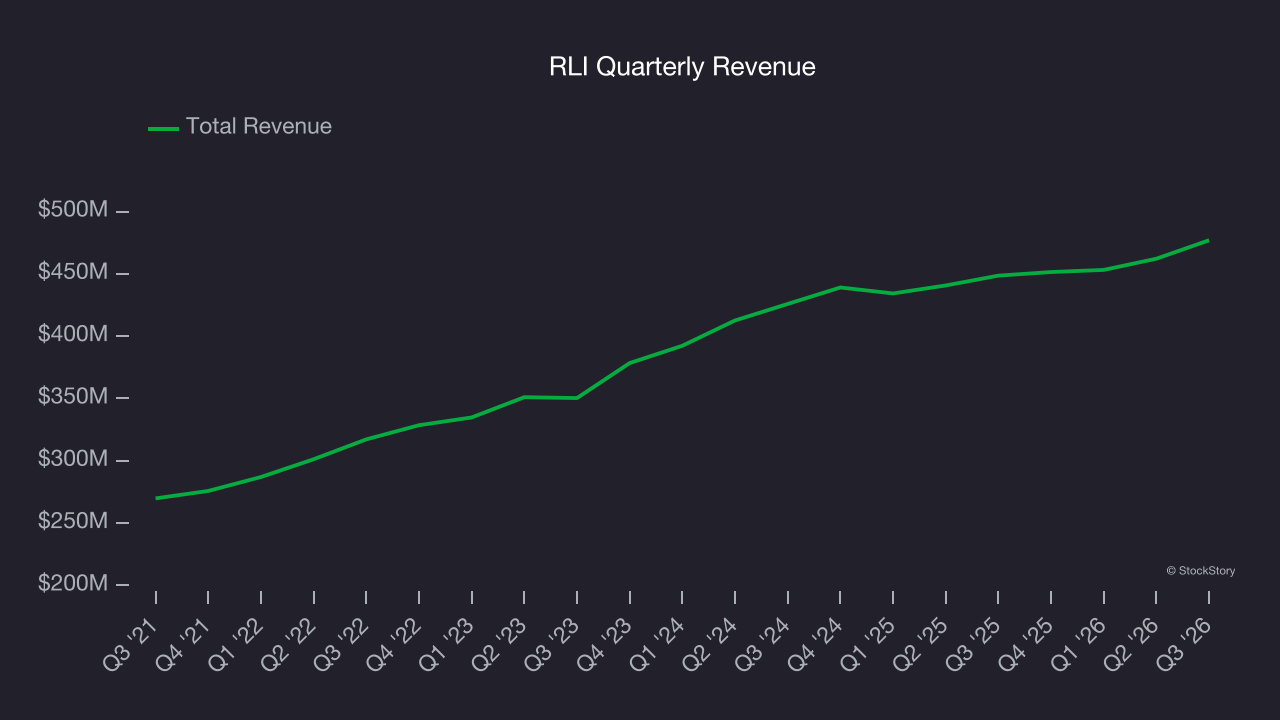
Long-term growth is the most important, but within financials, a half-decade historical view may miss recent interest rate changes and market returns. RLI’s recent performance shows its demand has slowed significantly as its annualized revenue growth of 7% over the last two years was well below its five-year trend. 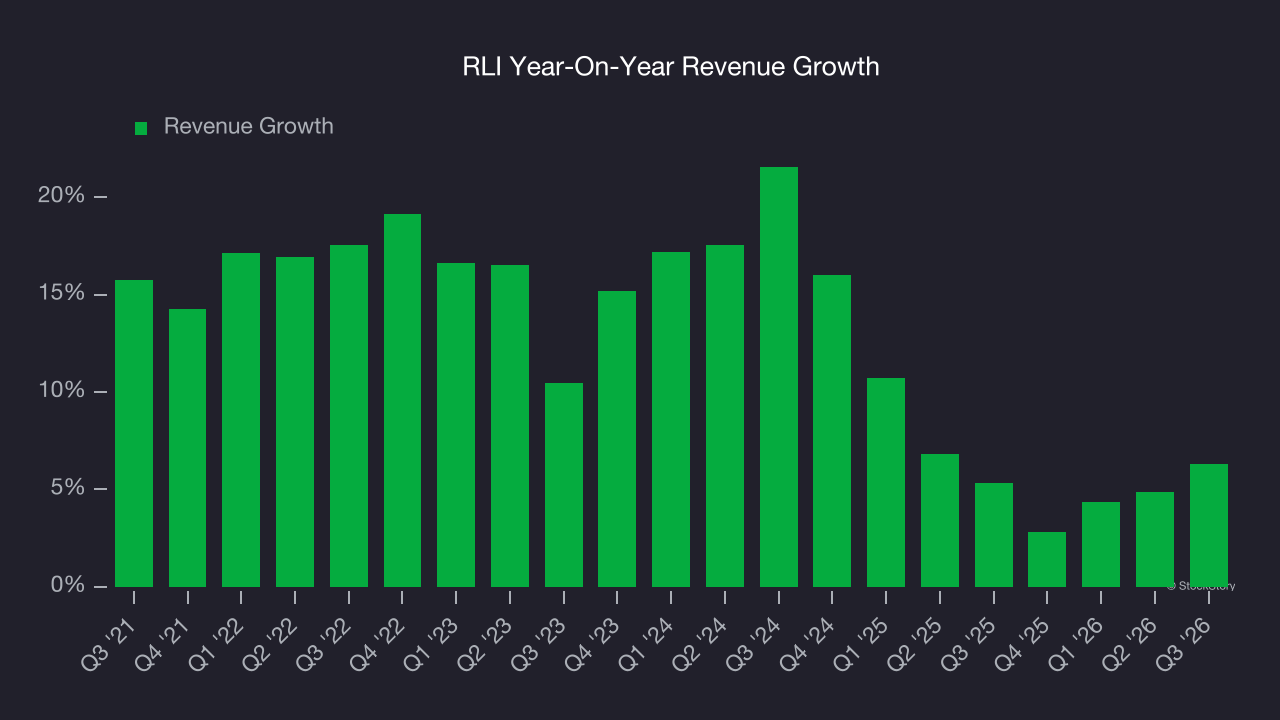
This quarter, RLI reported year-on-year revenue growth of 6.3%, and its $477 million of revenue exceeded Wall Street’s estimates by 1.5%.
Net premiums earned made up 91.4% of the company’s total revenue during the last five years, meaning RLI lives and dies by its underwriting activities because non-insurance operations barely move the needle.
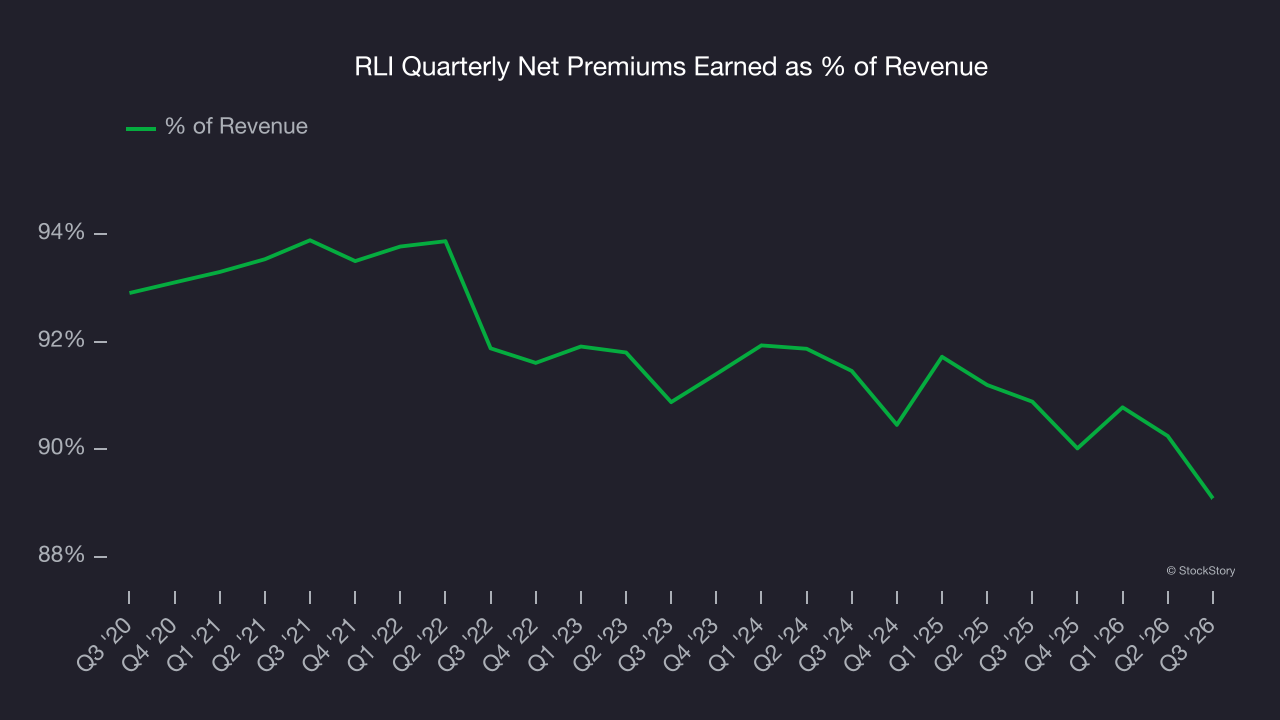
Net premiums earned command greater market attention due to their reliability and consistency, whereas investment and fee income are often seen as more volatile revenue streams that fluctuate with market conditions.
ONE MORE THING: 3 Hidden Platforms Growing 3X Faster than Amazon, Google, and PayPal. Amazon, Google, and Meta all followed the same playbook: Dominate an ignored market. Build an unbeatable moat. Scale until you’re unstoppable.
These three platforms are running that exact playbook right now. The early investors in Amazon made fortunes. The early investors in these could do the same. Get All 3 Stocks Here for FREE.
Book Value Per Share (BVPS)
Insurers are balance sheet businesses, collecting premiums upfront and paying out claims over time. Premiums collected but not yet paid out, often referred to as the float, are invested and create an asset base supported by a liability structure. Book value per share (BVPS) captures this dynamic by measuring these assets (investment portfolio, cash, reinsurance recoverables) less liabilities (claim reserves, debt, future policy benefits). BVPS is essentially the residual value for shareholders.
We therefore consider BVPS very important to track for insurers and a metric that sheds light on business quality. While other (and more commonly known) per-share metrics like EPS can sometimes be lumpy due to reserve releases or one-time items and can be managed or skewed while still following accounting rules, BVPS reflects long-term capital growth and is harder to manipulate.
RLI’s BVPS grew at a mediocre 6% annual clip over the last five years. On a two-year basis, however, dynamics have changed as BVPS dropped by 1.6% annually ($19.08 to $18.49 per share).
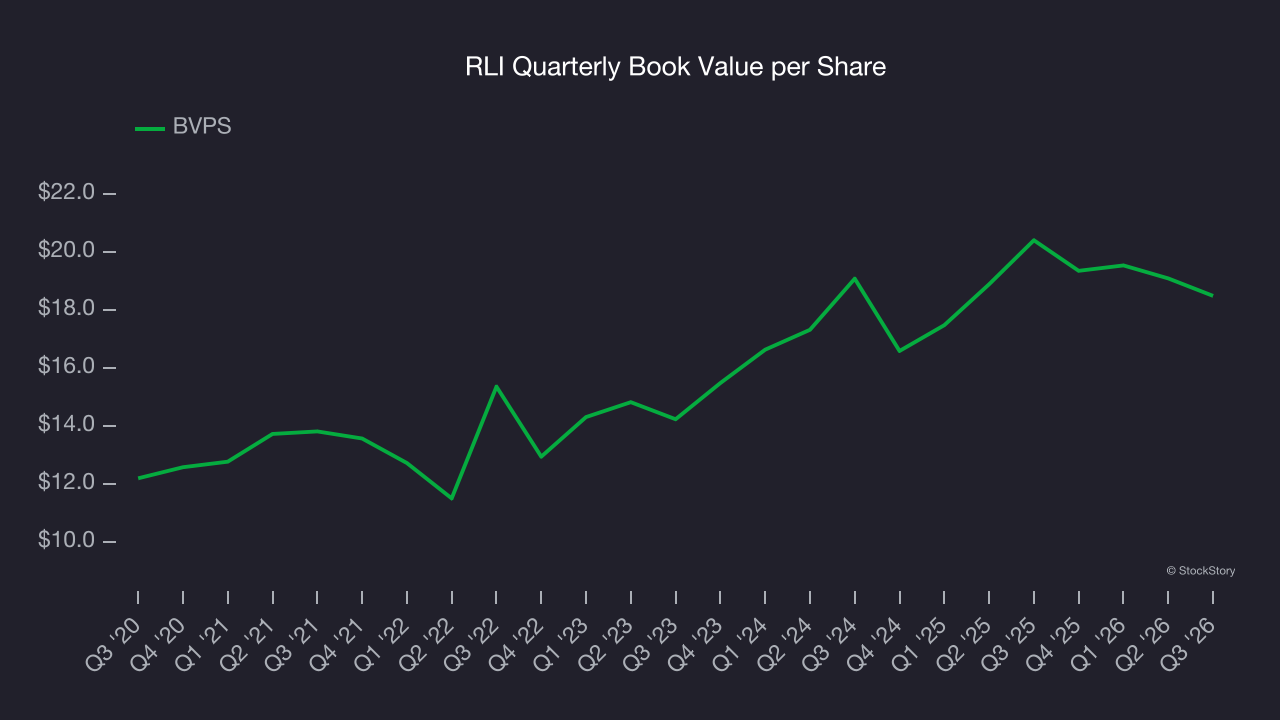
Over the next 12 months, Consensus estimates call for RLI’s BVPS to grow by 14.8% to $20.78, top-notch growth rate.
Key Takeaways from RLI’s Q3 Results
It was good to see RLI beat analysts’ EPS expectations this quarter. We were also happy its revenue narrowly outperformed Wall Street’s estimates. On the other hand, its book value per share missed. Overall, this print had some key positives. The stock remained flat at $60.80 immediately after reporting.
So should you invest in RLI right now? The latest quarter does matter, but not nearly as much as longer-term fundamentals and valuation, when deciding if the stock is a buy. We cover that in our actionable full research report which you can read here (it’s free).